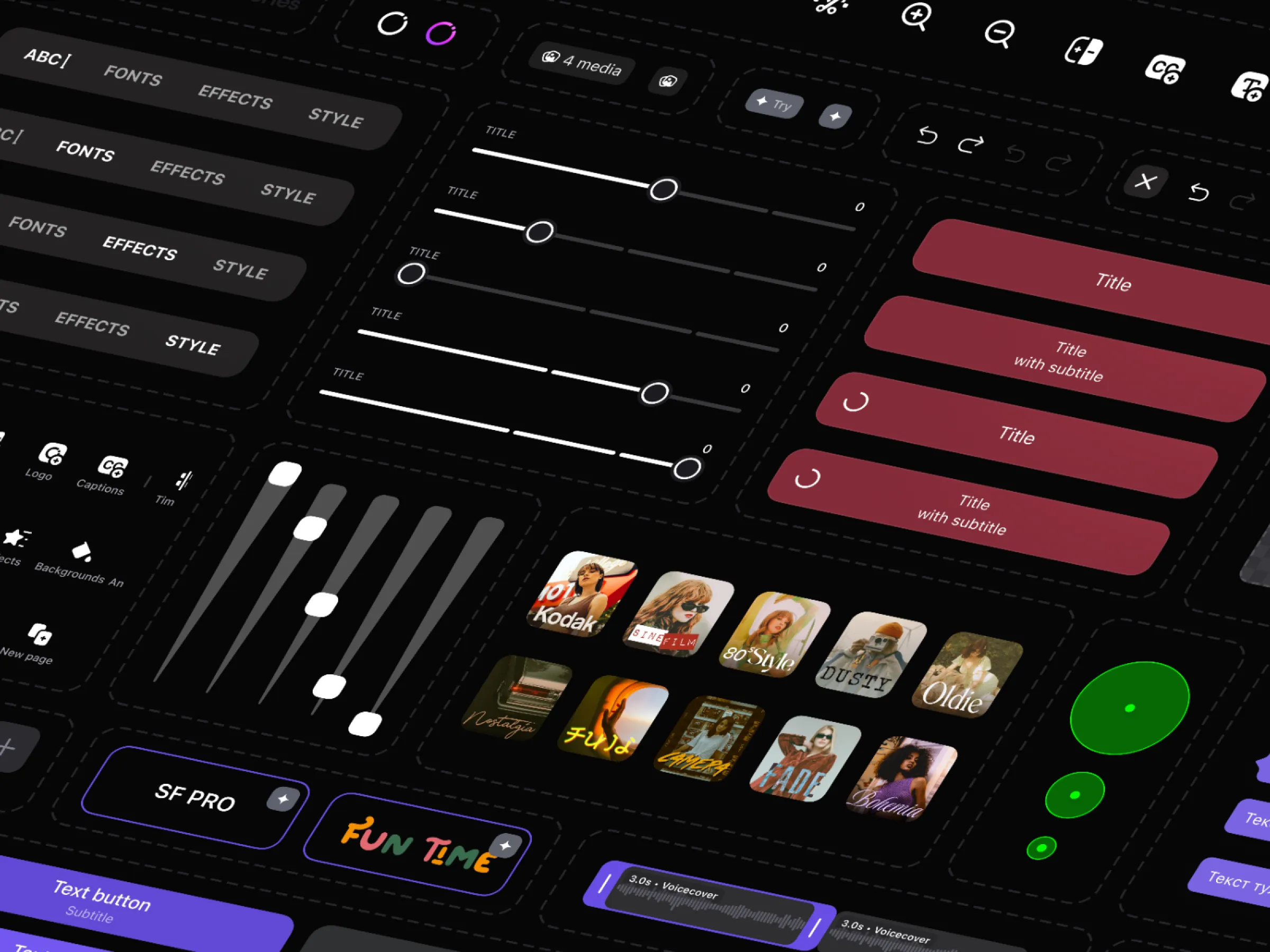

I work on digital products where the UI library looks impressive on paper but still struggles to survive contact with real projects. Over the last year, I have watched teams ship beautiful component sets, only to quietly bypass them when deadlines, edge cases, and new requirements hit.
Most teams do not suffer from a lack of components. They suffer from a lack of clarity.
You can have the cleanest Figma file in the world, a neatly named set of tokens, and a polished documentation site. If nobody knows how the system connects to business goals, how decisions get made, or what to do when the system does not quite fit a problem, the whole thing starts to rot. People fork components. Engineers copy and paste from old projects. Designers invent “just one” custom pattern that quietly becomes the new default.
At that point, the issue is not design craft. It is the missing strategy.
Components are the output, not the foundation
A lot of teams start their design system journey by drawing. They begin with buttons, form fields, cards, and layout grids. It feels concrete and productive. You can see the work. You can show it to stakeholders.
The problem is that components are the visible surface of decisions you have not made yet.
If you skip straight to drawing, you never answer questions like:
Which platforms matter most to us right now?
What kinds of products are we actually building in the next one to two years?
Which accessibility standards are non-negotiable for every release?
What performance constraints are our engineers dealing with?
Without those answers, your system is at best generic and at worst misaligned. You are designing for an imaginary product instead of the one your company is actually trying to ship.
Strategy means you decide what the system is for before you decide what it will contain.
A system is an agreement, not a gallery
A design system that works in 2026 behaves less like a style guide and more like a shared contract between design, engineering, and product.
That contract covers things like:
When you must use the system and when you are allowed to diverge
Who approves new patterns and who retires old ones
How changes get communicated and rolled out across teams
What happens when a squad needs something that does not exist yet
If these rules live only in hallway conversations and scattered Slack threads, you do not have a system. You have a gallery of components that everyone treats as optional.
A real system says: here is how we make decisions together when things are ambiguous. It gives people confidence that if they stick to the system, they will not be punished later for being “off brand” or “off pattern.”
Governance is not bureaucracy, it is how you keep trust
Governance has a bad reputation. It sounds like meetings and approvals and long documents nobody reads.
Done well, it is the opposite. Good governance keeps designers and engineers moving quickly because they do not have to renegotiate the same decisions on every project.
That might look like:
A small, cross-functional group that meets regularly to review proposed changes
Clear criteria for what qualifies as a reusable pattern versus a one-off solution
Versioning rules so teams know which components are stable and which are experimental
Simple channels for feedback from the people actually using the system day to day
Without this structure, every team ends up inventing their own “mini system.” You get five slightly different modals, three competing button styles, and nobody is quite sure which one is “correct.” Design review turns into arguments about taste instead of discussions about outcomes.
Adoption matters more than perfection
The most powerful design system in your company is not the prettiest one. It is the one people actually use when they are stressed, busy, and under deadline.
That means you need to optimize for adoption, not aesthetics. Some practical ways to do that:
Meet teams where they are: ship code packages, snippets, and templates in the tools they already use
Build examples around real flows, not isolated components floating in space
Prioritize the top scenarios that teams face every sprint, instead of trying to cover every edge case at once
Invest in onboarding: short walkthroughs, office hours, and friendly support for questions
If using the system feels heavier than just hacking something together, people will always choose speed over purity. Strategy means making the system the fastest path to “done,” not the most correct path on paper.
Connect the system to real outcomes
The surest way to prove that your design system is more than a vanity project is to tie it to metrics that matter.
That might be:
Faster time from concept to first prototype
Reduced number of accessibility issues detected late in the cycle
Fewer one-off UI bugs across platforms
Higher consistency scores in UX audits or user research
When you can say, “Using the system shaved two weeks off this release,” or “The new component set helped us hit accessibility requirements on the first try,” suddenly the conversation changes. The system stops being “design’s thing” and becomes a shared asset for the entire product organization.
The designer’s role is evolving
In this world, the designers who thrive do more than draw components.
They:
Translate product strategy into system principles and constraints
Mediate between teams when there is tension about patterns or exceptions
Craft documentation that is honest and practical, not just pretty
Keep a pulse on how the system feels to use, not just how it looks to browse
You still need an eye for detail. But the details that matter shift. Instead of obsessing over every state of a single button, you care more about whether a new team in another time zone can understand and use that button without a one-on-one call.
A design system built on components alone will always feel fragile. The moment pressure hits, people route around it.
A design system built on strategy, clear agreements, and shared ownership can be a quiet superpower. It lets teams move faster and more consistently. It turns design from a service into an infrastructure.
In 2026, that is the real mark of a mature practice. Not how beautiful your component gallery looks, but how confidently your teams ship when things get messy.